My BCM320 digital artefact can be accessed HERE
Auto-ethnographic reflection on week 3
Reflection is an important aspect of auto-ethnographic research as it allows for change. In week five, I uploaded a blog post where I focused on my own auto-ethnographic experience with anime on Netflix; Kakegurui. In this blog post, I will be analysing this experience and evaluating how one of the main components in auto-ethnographic research is the researcher’s self-reflexivity and reflection upon investigation. Moreover, this blog post will be an analysis of my own auto-ethnographic experience where I will draw on the Ellis et al. reading (2011), to use the methodology to investigate my narrated experience in blog post 3.
Since initially embarking on the journey of discovering more and more Japanese anime films on Netflix, I have begun to experience many moment of epiphany. I have mentioned in my previous blog post, I had not really come into contact with Japanese anime before, therefore hardly knew anything about it. I have experienced that a growing number of people are realising that anime is not a genre like western animation, but rather an artistic format to tell an array of different stories. Three weeks after blogging about Japanese anime, I have found myself immersed in the culture.
By immersing myself in Japanese anime, I have realised how powerful auto-ethnographic communication can be; as Ellis et al. (2011) states, autoethnography expands and opens up a wider lens, eschewing rigid definitions of what constitutes meaningful and useful research. This quote by Ellis helps me understand that I must analyse my own personal experiences (in the form of epiphanies) and reflect on cultural experiences during these epiphanies. In my previous blog post, I focused on character design – (a Japanese girl looking more like a European woman), now looking back, I wish I had focused on a few more themes in the series such as gambling/risking our sense of self, good and evil and the nature of existence. Epiphanies that I have experienced were structured around using my own cultural background to understand the themes of Kakegurui and I must reflect upon how influential my cultural framework is in defining my research. As Ellis et al. (2011) mentions, it is important to use personal experience to illustrate facets of cultural experience, and, in doing so, make characteristics of a culture familiar for insiders and outsiders, therefore, I have come to understand that the research I have and will conduct, will differ greatly to others.
I believe that part of what makes anime so appealing to an American/Australian audience is the way it so closely resembles American and Australian popular media. In my initial blog post, I briefly mentioned ‘over recent years, the popularity for anime and its comic strip counterpart manga, has considerably grown in the UK and West’ – many of the genres and stock characters found in Hollywood movies and American television appear in anime, (Newitz, 1994). Often, anime make overt references to American popular culture, or feature Western characters; this is what I discovered when I immersed myself in the culture and referring to Ellis et al. 2011, the immersion of oneself into an authentic cultural experience is a crucial aspect of autoethnographical research.
Below, I have attached a video of how Dragonball changed anime in the west – something I will look further into a long with anime in the western culture.
To conclude, my personal experience has been quite extensive so far, experiencing cultural epiphanies and immersing myself into another culture. Reflecting on this post and my previous blog post, I have broadened my understanding of how anime has influenced the western culture but also the similarities and differences in different cultures.
Until next time …
References
Newitz A, 1994, ‘Anime Otaku: Japanese animation fans outside Japan’, Bad Subjects, vol. 13, no. 11, pp. 1-14.
Ellis, C, Adams, T & Bochner, A 2011, ‘Autoethnography: An Overview’, Forum: Qualitative Social Research, vol. 12, no. 1.
Kakegurui -An auto-ethnographic approach to Japanese anime
So far, Digital Asia has proven to be eye opening where I have been able to immerse myself in different Asian cultures each week. Starting out, I had only ever come into contact with a Japanese anime film once before which was in a previous subject, Future Cultures where I watched Ghost in the Shell (which, by the way I totally forgot to mention this in my previous blog as I said I had never come into contact with this style of film before).

While I was scrolling through Netflix, a Japanese anime film popped up, called Kakegurui. I have never watched anime on Netflix as you could say, it definitely would not be my first choice, reading subtitles can become draining and make me lose interest quite quickly. However, Kakegurui stood out to me as I thought to myself, this could be something to write about for my blog post and maybe, I could focus on Japanese anime for my digital artefact, so I thought, why not take this opportunity to immerse myself in Japanese culture and auto-ethnographical research and develop a wider understanding.
Kakegurui – Compulsive Gambler surprised me as I was expecting subtitles as I knew it was Japanese culture, but it opened with the characters speaking english. Before watching a couple of episodes, I was expecting a different character design (ones where the characters were obviously of a Japanese background), however, the characters look of European appearance. Mary, a character in Kakegurui has very distinct European features such as long blonde hair, fair skin and brown eyes; a design that doesn’t fit into the ‘typical anime character’.

Mary Saotome – the main protagonist of the spin-off series, Kakegurui Twin.
Anime and manga have long been at the heart of Japanese culture, with a consistent wave of popularity between the generations. Over recent years, the popularity for anime and its comic strip counterpart manga has grown considerably in the UK and the West. The reflective nature of this post enables me to become critically aware of my own deep feelings and enables me to contextualise my ideas, thoughts and understandings into broader socio-cultural phenomena. The immersion of oneself into an authentic cultural experience is a crucial aspect of autoethnographical research, (Ellis et al. 2011), hence the discovery of Japanese anime on Netflix, I plan to watch more cultural films to deepen my understanding of cultural sensitivity.
I found, in my experience so far, that a few epiphanies and key moments have stood out to me, being transformative to my own understanding of Japanese culture. Overall, Japanese culture has not only influenced the way I think about other cultures, but my own autoethnographic experience with the Digital Asia topic. By using my assumptions and experience with Japanese anime so far, I will be able to cultivate understanding as Ellis et al. 2011 quotes, ‘autoethnographers must not only use their methodological tools and research literature to analyze experience, but also must consider ways others may experience similar epiphanies; they must use personal experience to illustrate facets of cultural experience’.
AKIRA: AN ETHNOGRAPHIC REFLECTION
Walking into this weeks seminar, I was a stranger to Japanese anime films so was not sure what to expect from the film. The film became a classic, with a $9 million budget and hitting $49 million in the box office. The film is relatable – always one hero trying to save the world from some sort of corruption and a chaotic government. The Japanese anime film, Akira, intertwined with elements of a westernised culture that I am familiar with. For example, Kanye West, an American rapper and music producer proclaimed his love for the film via twitter and commentary in his music video for his pop hit, ‘Stronger’.

Over the past three weeks, I have allowed myself to slowly deconstruct the idea of an auto ethnographic approach, making me able to be more self-reflective in understanding many different cultures including my own background.
Ellis et al. (2011), defines auto ethnographical research as the step by step process of ‘retrospectively and selectively writing about epiphanies that stem from, or are made possible by, being part of a culture and/or by possessing a particular cultural identity’. When writing an auto ethnographical approach, I begin to think of how my cultural background and beliefs create a perspective in the way I view and think about other cultures. Anime is a completely new genre for me as I have only come into contact with it once before when playing ‘Pokemon go’ a few years back (which is Japanese anime). As Ellis et al. (2011), states, ‘autoethnographers must not only use their methodological tools and research literature to analyze experience, but also must consider ways others may experience similar epiphanies; they must use personal experience to illustrate facets of cultural experience’, I was constantly comparing the film to the only anime I had seen before and trying to find links so I could connect to the film.

Throughout the film, Akira, I was quite self-reflective, tweeting how Akira is a complex and challenging work of art that provoked, bewildered and occasionally inspired western audiences when it was first released in Japan. I also tweeted how the producers depicted the future quite well with terrorist attacks and bombings occurring in the world today – this was me critically analysing a personal lived experience (in a way).

Overall, this is my own auto ethnographic experience and interaction with Akira; me ‘considering ways others may experience similar epiphanies, using personal experience to illustrate facets of cultural experience’, (Ellis et al. 2011). It was only after reflecting on other people’s experiences of Akira (through their live tweeting), that I began to rethink my initial impression of the film. I began to feel emotion for the character Tetsuo as he was transforming into a walking black hole, not being able to control his transformation.

Week 1 blogging BCM320
‘The Host’ (2006) is a South Korean ‘monster film’ directed by Bong Joon-ho that focuses more on a dysfunctional family with an alcoholic brother, rather than an eastern culture horror film. The monster fish was introduced into the film within the first ten minutes, instead of there being a suspenseful build up. I found that the movie itself is no less dexterous, suddenly twisting from horror to comedy with extremely over the top reactions in certain scenes, such as the mourning of Hyun-seo which makes it more of a comedy.
The music in certain scenes could really transform emotions and feelings of the viewers as the music was not dramatic and dark, however it was almost light to make it comedic. The monster movie genre is a product of Hollywood and Japan – it is not a staple of South Korean popular culture. Japanese and the American influence on South Korean culture are felt through genre choice. The film itself is eastern culture, which I can relate to as I have visited some eastern cultured countries such as Singapore, Thailand and Vietnam. Every family member represents the cultural background of Korea in many periods and when Gwang-du realises that the monster has taken his daughter, he risks his own life to do anything to get her back – this is something my family would do for me. The whole film is embodiment of a father’s love for his daughter as he does not stop looking for her once she is taken by the monster. I do not have any experience with Korean culture, however the film did not confuse me as it was quite easy to understand and follow; even with subtitles.
I tweeted here about the film being spoken in Korean, but translated to English, and then Angus mentioned that ‘translations are an interesting language and cultural negotiation worthy of study in their own right. They are never literal and “perfect”, and lots of judgements and cultural political input is given to the translators’. I reflected on this in the movie, understanding that not every exact word that was said in Korean, would translate to perfect English. Below, I have included an interesting article that I skimmed – on why American studies needs to think about Korean cinema or translational genres in the films of Bong Joon-ho.
https://www.jstor.org/stable/40068554?seq=2#metadata_info_tab_contents
Overall, I enjoyed the movie The Host and am looking forward to watching more films that involve Asian culture where I can relate my own cultural background to those who star in future films.
ROBOTICS IMPACT ON SOCIETY: THE FUTURE
Hi everyone,
This is my third and final stage of my digital artefact for BCM325. I decided to switch it up and do something a little different. I did a voice over of myself predicting the future impact of robotics which I posted to my YouTube channel. Please go check it out!
Contextual Essay BCM325
My three-stage digital artefact for BCM325 has allowed me to acquire and demonstrate skills in conceptualising and developing a digital media project. My project addresses the future cultures in a 3-stage project, conveying the effects of robotics on culture and society in the future and the evolution of robotics and technological innovations over the past 50 years. My project approached the future cultures DA challenge by addressing the future of robotics impact on society and culture. I speculated on an entirely new future; not following on from observable patterns and trends, but, making my own prediction of the impact of robotics on society and culture.
Projects concept
My project’s concept was to construct a 3-stage artefact, firstly addressing the past and the technological innovations shaped over the past 50 years because ‘while robots are a fixture in the automotive industry, advancements in safety systems, end effectors and sensors are rapidly bringing robotics into new applications’, (Brumson, 2011). The second stage was where I conducted primary research such as a survey to capture my peer’s perspectives on the impact of robotics on society today. This stage was to prove how robotics are having an impact on society today, which was done through extensive research using academic articles and feedback from my peers but also my tutor. The third and final stage was a video of myself predicting the future impact of robotics on society and culture within the next 25 years. Overall, my project anticipates an audience by portraying a strong meaning that robotics is impacting our society and will impact our future in some way.
Methodology
Through different types of research including academic articles, news sources and primary research, I was able to produce a digital artefact on my blog on WordPress that addresses the future cultures. I created my survey to get response and results along with opinions. Academic articles that are referenced in my blog posts also helped me to gain knowledge on the impact of robotics on society and culture along with news articles online.
Background research
Looking into further research aided me in creating a digital artefact that addresses the future, but also the impact of robotics. Social media sites such as Twitter and Facebook depicted posts about the rising of robots and the effect they may have on society (e.g. loss of jobs for humans). Academic sources and articles along with YouTube videos of the impact of robotics also aided me in researching further into the effect of these robots on culture and society. Overall, background research has been a large component in assisting me to create a digital artefact that addresses the future cultures. Responding to feedback, not only from my tutor, but also my peers, allowed me to change aspects of my DA to fit the future cultures well.
Links from my peer’s feedback that I utilised are linked below. You can witness the changes from my beta presentation to my final digital artefact in my blog where the feedback has been utilised. I changed the heading of my first blog post to make my audience more engaged and grab their attention, I narrowed my main idea down so I wasn’t overloaded with work (shown in my beta presentation), I post my blogs to my twitter account to gain a wider audience (https://twitter.com/emhawken15/status/1135368436899549184) and I touched up on the impact robotics will have on personal lives and family relationships.
https://emhawken.wordpress.com/2019/05/03/beta-presentation/
Utility
Reflecting on my digital artefact, I have justified that it has a use for an audience. I have justified this through my twitter account – posting each blog to my page for a wider audience and specific research for my audience’s feedback (survey). Furthermore, the overall trajectory has seen a digital artefact produced that addresses the future cultures and the impact of robotics on society and culture over the past, present and future. Appraising my project’s success and limitations, there has been a numerous amount of changes and iterations to better suit the future effect of robotics and to address the future cultures. I would have liked to complete a one-on-one interview with someone and view their ideas and thoughts on why they think robots are taking over, but I believe my digital artefact has been a success in researching why robots are continuously rising to better suit our lifestyles.
ROBOTICS IMPACT ON SOCIETY: TODAY
This week I decided to do some primary research such as a survey to see other’s perspectives on the impact of robotics on society today.
Below, I have pasted the survey I asked six people to complete to discover their views and opinions on robotics impact on society today.

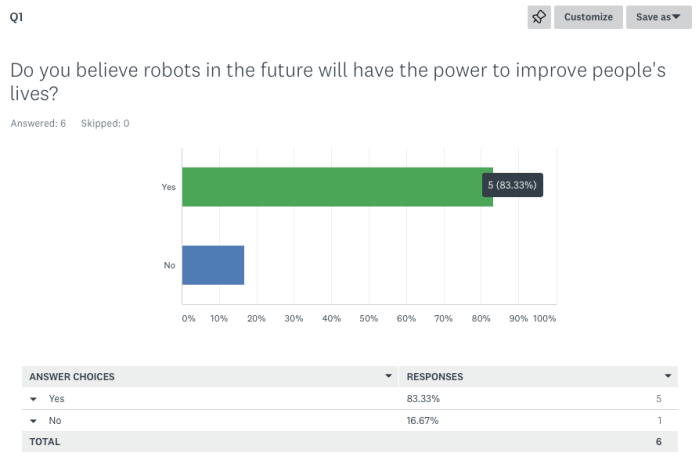
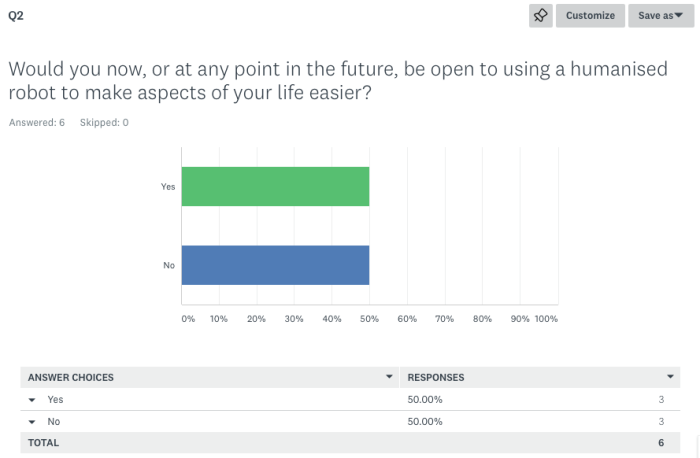
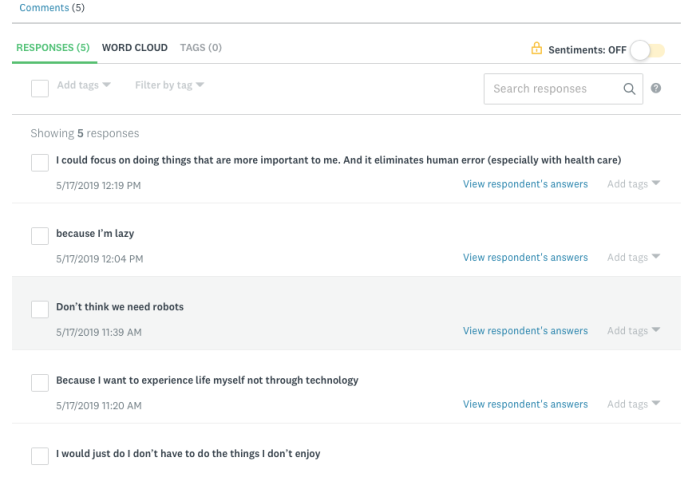
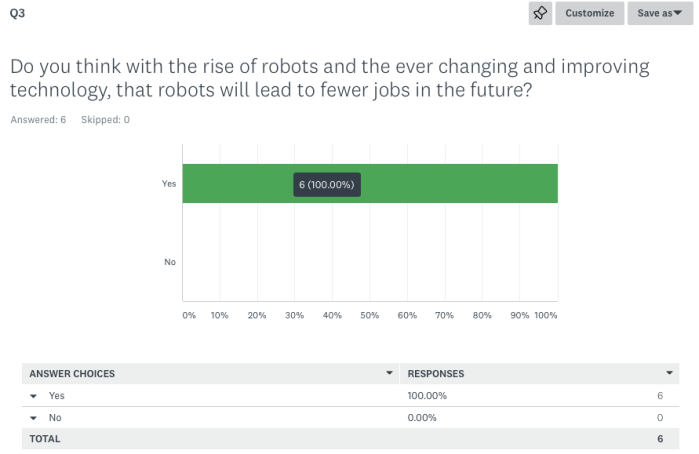
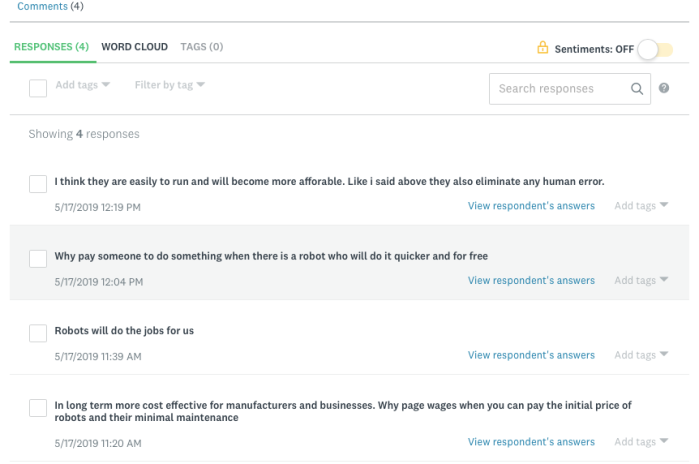
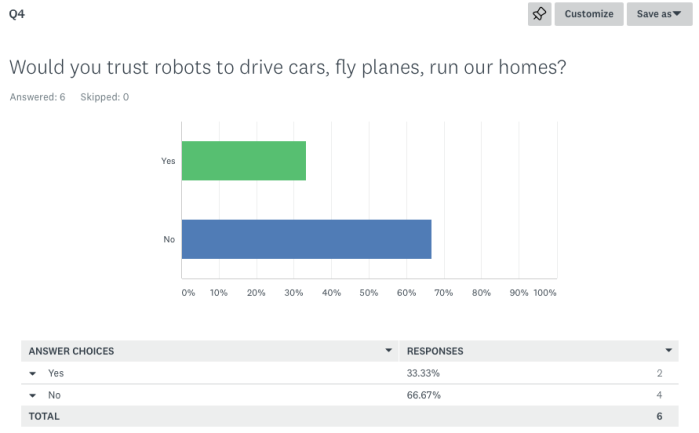
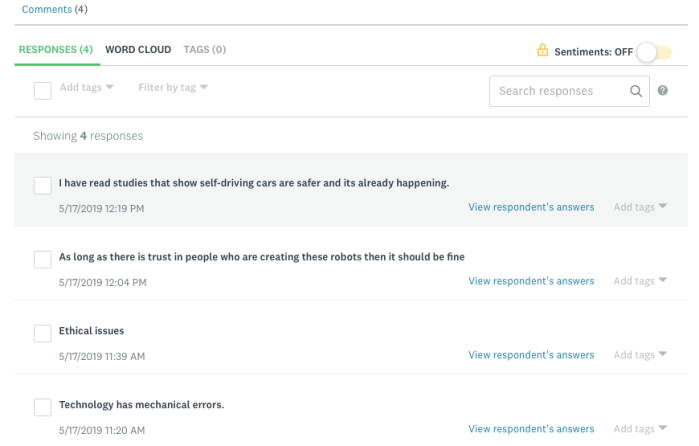
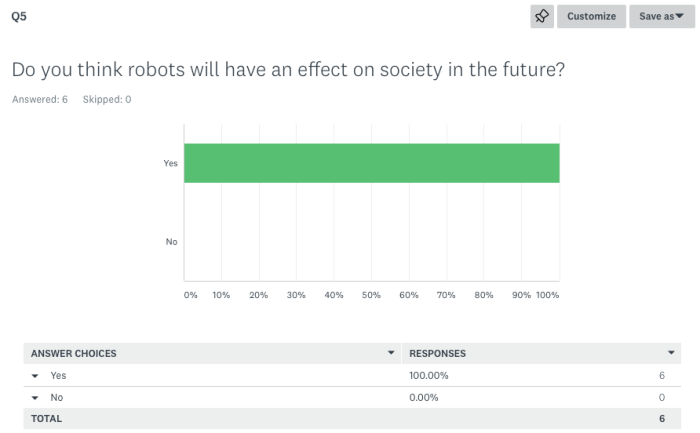
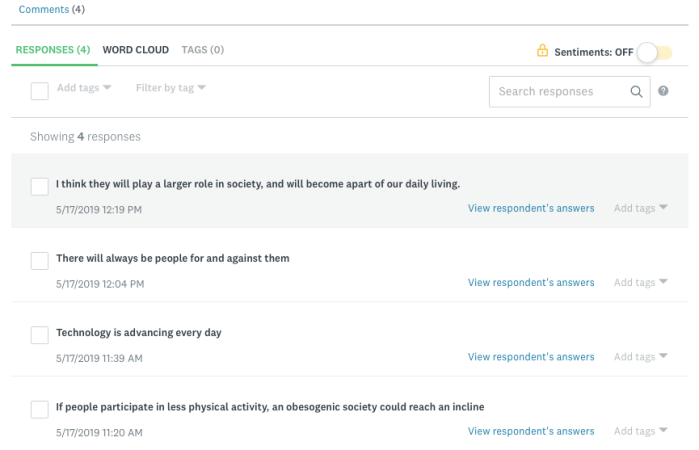
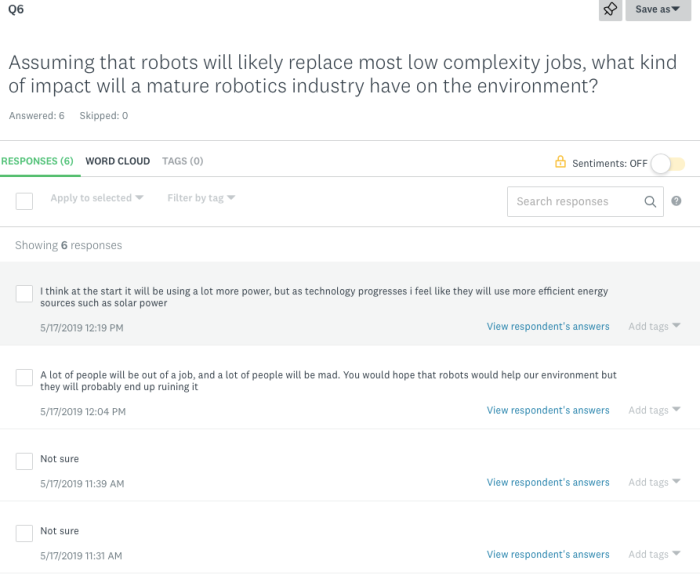
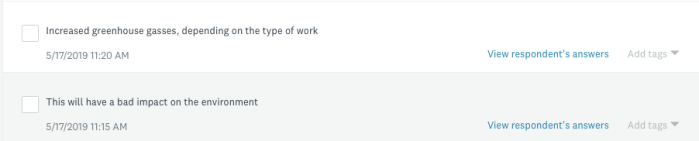
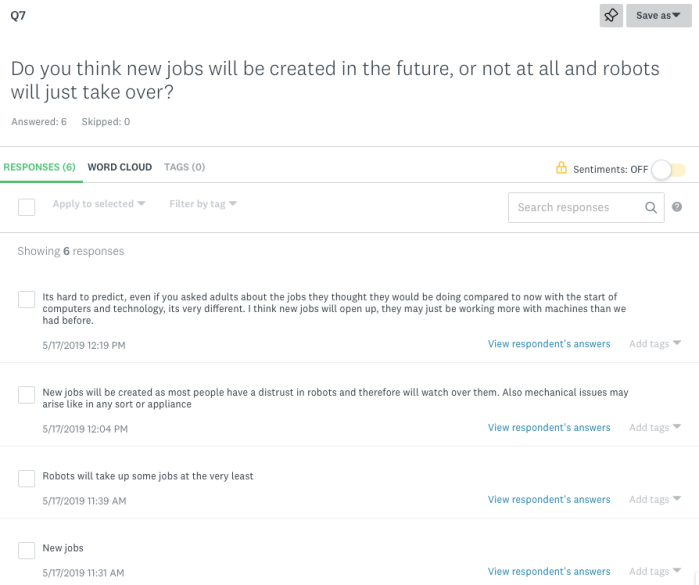
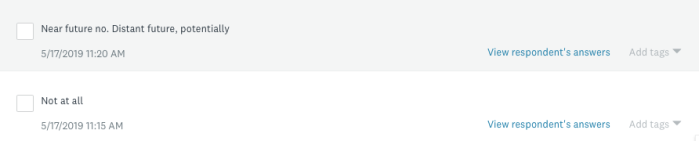
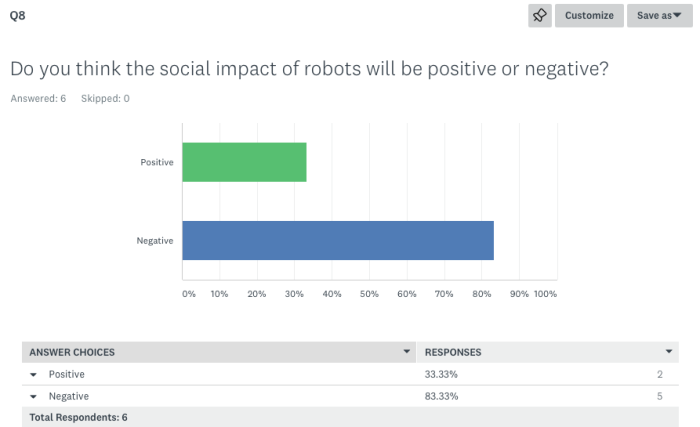
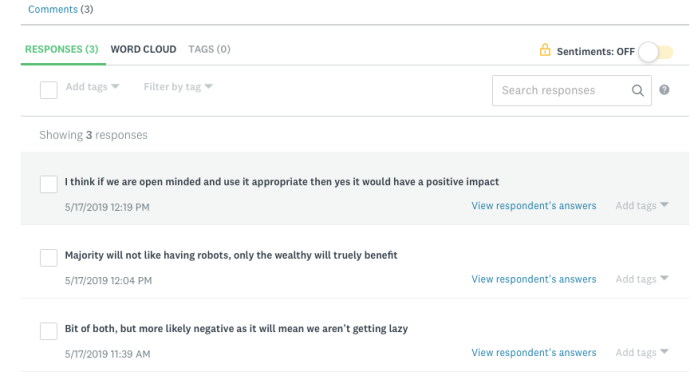
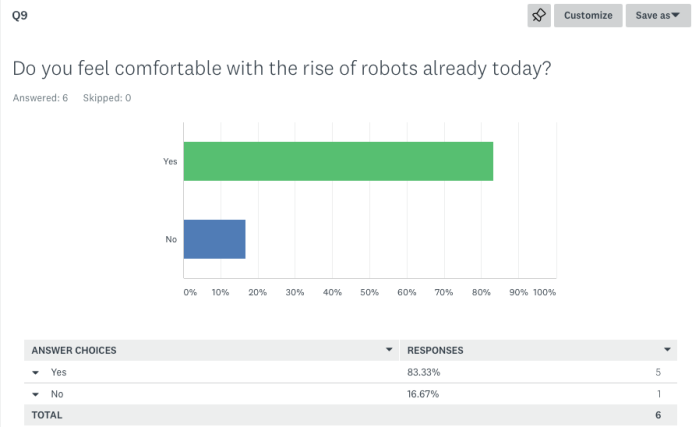
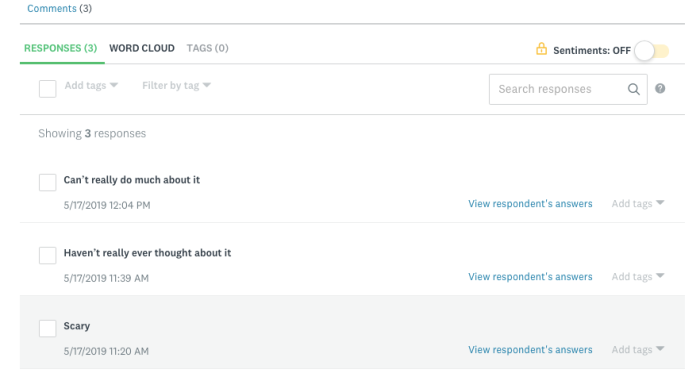
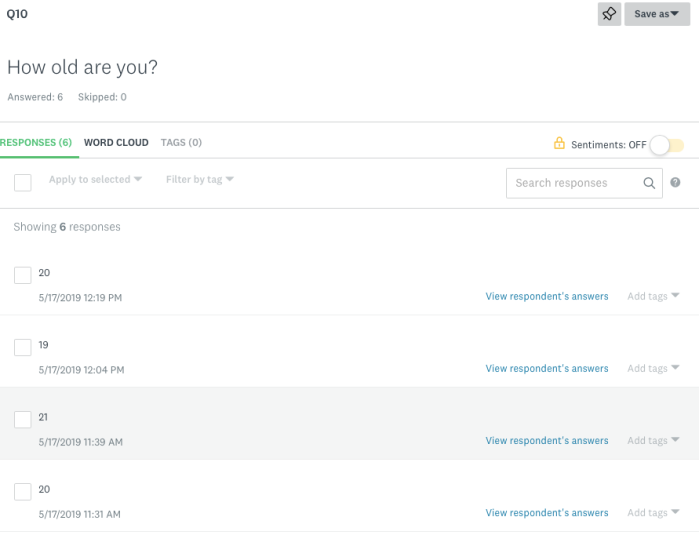

The main reasons for conducting a survey was to evoke discussion and give my survey respondents an opportunity to discuss important key concepts. Conducting surveys is an unbiased approach to decision making and to base decisions on objective information. My survey results provide a snapshot of the attitudes and behaviours towards the impact of robotics on society today and in the future.

EXAMPLES OF ROBOTS TODAY
‘The emergence of robotics culture, which is facilitated by the potential of cohabitation between humans and robots, not only raises issues of robot abilities but of human vulnerabilities, as well as the ways robots effect our lives’, (Samani, et al.)
TODAY, robots assist the elderly in nursing homes such as assertive robots. In contrast to interactive robots, assertive robots focus on aiding humans with special needs.
‘Assistive robotics in general and socially assistive robotics in particular have the potential to enhance the quality of life for broad populations of users: the elderly, individuals with physical impairments and those in rehabilitation therapy, and individuals with cognitive disabilities and developmental and social disorders’.
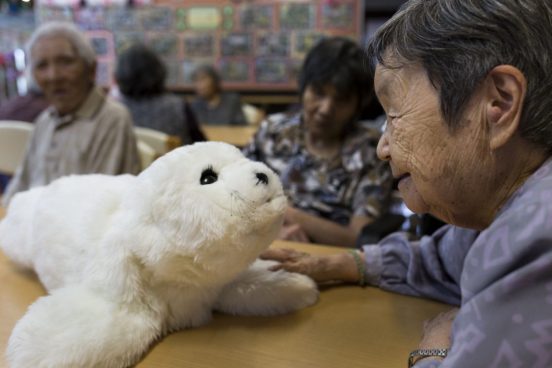
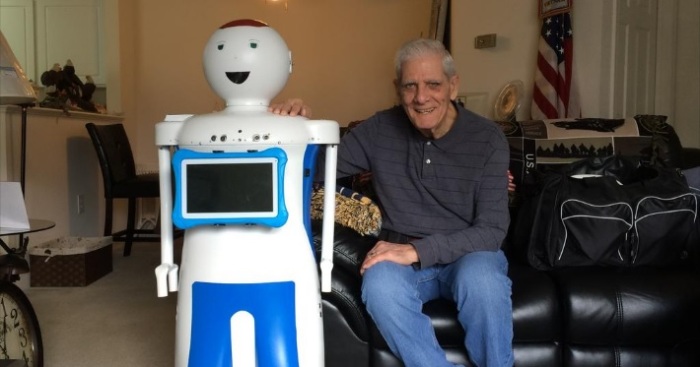
The field of science and technology has changed dramatically over the past decades, changing our perspective on life. Robots have become significant by trying to replicate humans. With the evolution of robotics and technological innovations, there are always good and bad effects of robots. Firstly, starting off with the benefits of robots on society today, the first thing we can look at is disability robots.
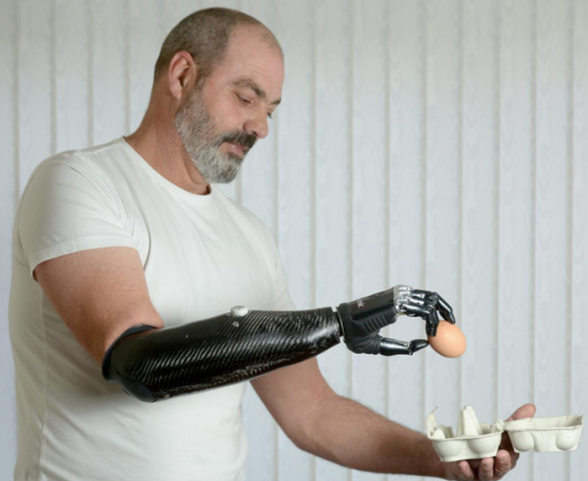
- Disability robots have been designed to aid people in their recovery from certain diseases/injuries/conditions. This field includes robotic arms and robotic devices that help people with daily tasks.
2. Productive work
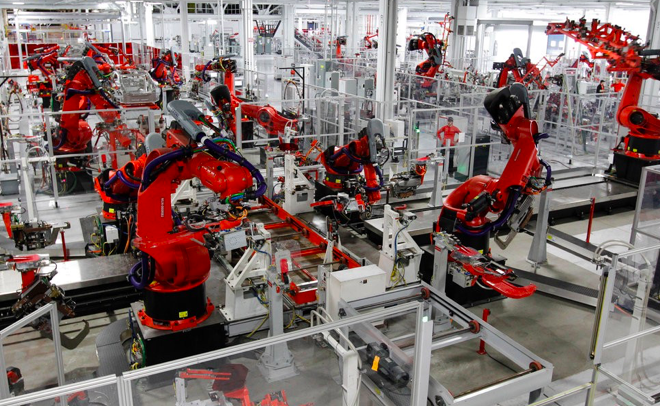
Hundreds of factories use robots today to make the job go by faster and with no mistakes. Robots in factories are more efficient and time saving and as long as they have power, they can continuously work 24 hours around the clock and does not get tired like humans.
3. Safety
Robots protect humans from performing dangerous tasks in the workforce. They can work in hazardous conditions and are capable with lifting heavy loads without getting injured or tired.
4. Savings
Robots save time by being able to produce a greater abundance of products, but also reduce the amount of waste due to their accuracy.
____________________________________________________________________________________________
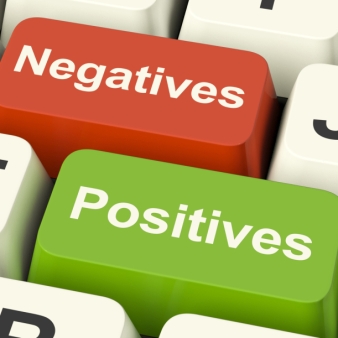
Looking at the negative effects that robots have on society, first we can look at loss of jobs.
- Many companies and factories have turned to using robots instead of paying humans to complete jobs as it is more cost effective. Robots have begun to overtake humans in the workforce which is threatening the job market.
- Over attachment – with robots being built to look exactly like humans (Sophia for example), people can grow an emotional attachment. Could this cause problems when robots aren’t around?
- Becoming lazy – robots can have a negative effect on humans as they are doing manual labour. This negative effect can lead to humans becoming more obese which can lead to health issues such as diabetes and high blood pressure.
Overall, this weeks purpose was to look at and research the effects that robots have on society today. From above, you can see the primary research that was conducted to get some evidence as to why robots can have a positive and negative effect on society and culture today. Stay tuned for episode 3 of my digital artefact for BCM325.
References
Samani H, Saadatian E, Pang N, et al. 2013, ‘Cultural Robotics: The Culture of Robotics and Robotics in Culture’, International Journal of Advanced Robotic Systems, vol. 10, no. 12, pp. 1-10.
Tapus A, Maja M & Scassellatti B, 2007, ‘The Grand Challenges in Socially Assistive Robotics’, IEEE Robotics and Automation Magazine, vol. 14, no. 1.
Live Tweeting BCM325
WEEK 8 – I, ROBOT
Week 8 saw the screening of I, Robot. While live tweeting this week, I began to add more academic sources and articles to my tweeting as evidence for what I was tweeting about. For example, in this tweet I mentioned that there were not as many robots walking around in the film, however it was the year 2035; therefore my next tweet was an article I found online about robots taking over humans in the future, which allowed for my peers to read.
Analysing this tweet, I decided to make an obvious statement about the future being similar to nowadays. I also decided to ask a question in my tweet to spark a conversation and engagement with my peers.
WEEK 9 – ROBOT & FRANK (2012)
In this tweet I wanted to include a news article about how a certain robot called ‘Paro’ can make the elderly feel less lonely and help them in many ways. Analysing this tweet, I decided to add the article to portray the similarities in the film and how Frank feels lonely without his robot companion. This week, I gained a few likes in a few of my tweets, mentioning the key themes in this tweet , how strong human relationships can be in this tweet and also mentioning how important companionship is in this tweet, which I found online.
I also engaged with a few peers this week, retweeting and liking other people’s tweets to spark a conversation, such as my tweet about companionship where I got a reply from another student.
Critically analysing week nines tweets, they are evidence of some research through shared links to relevant sources.
WEEK 10 – MARJORIE PRIME (2017)
At week 10, I was articulating my thoughts which made it uncomplicated to bring forth discussion. I was engaging with my peers quite well and tweeting factual information about the film in this tweet which gave me 4 likes and 2 retweets. I thought this link would be an eye opener to convey a new type of artificial intelligence in the film. Critically analysing, I was learning about artificial intelligence in the future in more depth through my own tweets and retweets from others such as Matilda’s tweet.
This week, I made a strong tweet that gained a lot of attention due to the fact of me asking a serious question that got other students thinking. The tweet gained a lot of attention because it could be what the future holds for us.
WEEK 11 – Blade Runner 2049
This week was the most tweeting I have done in a period of time. I tweeted two articles I found online (first one here), to convey how the future of technology reflects our present. I thought this was a great idea for my peers to read and reflect on how the future may change with the continuous evolution of technology. The second article I posted mentioned the themes in the film – ranging from cloning to female stereotypes which reeled in 3 likes and 2 retweets. The point of this tweet was to for my peers to think of all the different themes in the film and what they meant.
Other interactions with my peers such as retweeting, favouriting and sparking conversation can be found here: first, second, third, fourth. My tweet about the sounds in the film was a tweet that didn’t focus on the picture, but on the way the music was making the audience feel for people to think about their feelings.
WEEK 12 – The Matrix (1999)
Reflecting on The Matrix, my tweets were far more insightful and research-based with a lot of engagement. This tweet pulled in nine likes and retweets as I commented on the picture image and colours in the film. Angus pointed out that the directors in the film came out as transgender a few years after the making of the film which reshaped my research as I looked for articles on the film and tweeted about the film being a coming out movie which sparked a response from Angus.
Overall, I genuinely enjoyed live tweeting and reflecting on my tweets each week. Each week I engaged with different peers and created conversation to articulate my thoughts.
Beta Comments
Providing feedback to three of my peers on their beta presentations will hopefully help them in their final project proposals.
Firstly, I listened to Rumeysa’s beta presentation. Her proposed project focuses on her researching into targeted advertisements and how often we come across ads about topics that we talk about. My comment on Rumeysa’s digital artefact can be seen here. Her artefact is going to be an animation about what this type of advertising can bring in the future.
Reflecting on my comment, I mentioned how I liked the idea of making it a creepy mood – this is a good reflection of how targeted advertisements can be freaky. I suggested that she could look at other technologies such as google home and Alexa to give her another idea for her digital artefact. The main reason for this was to help motivate Rumeysa in creating a great digital artefact. I left her a link (found here), which can help her with talking about other devices and how they can take advantage of people in a way. I believe my feedback will help Rumeysa learn more about targeted advertisements where she can reflect on my comment and use my feedback to create a great digital artefact.
My second comment can be accessed here.
Ruby is launching a podcast series called ‘Music Bizniz’, which encompasses Ruby doing one on one interviews with local artists in the area. Her original idea was to create a 3-part podcast series and link it to a previous project she is completing in another subject, however she thought her question in her other subject was too broad therefore, her project now has turned into an interview series that is posted to YouTube and Soundcloud once a week that focuses on changes in the music industry and how these changes will extend to the future.
Reflecting on my comment on Ruby’s post, I believe my feedback has the potential to be very helpful in creating a successful podcast and digital artefact. I offered Ruby two links to sources that can give her some suggestions to focus on in more depth. I said that her podcast series is a unique and relevant one to focus on as we don’t know what the future holds for the music industry. The first link can be accessed here, which offered an idea to Ruby that she can focus on the future being an uncertain adventure for music artists. The second link provided an idea for Ruby to look at the effects of Spotify being a competitor for record labels. I offered these links to spark new ideas that can be researched in depth as they relate to the future of tech/music culture of the future. I believe my feedback was valuable information that can be used to make important decisions for Ruby’s digital artefact and my comment was predominantly complementary.
Lastly, my comment on Georgia’s beta presentation can be seen here. Georgia’s digital artefact is to emphasise the effect of physical health (body image) and to educate the risks involved with this on her instagram. She posts photos to her account highlighting the extremes that image editing allows us to easily manipulate photos.
Critically evaluating my comment on Georgia’s post, I decided to encourage her into looking at articles online that convey the effect of body image on both men and women. The first source, I decided to offer her an idea that she should focus on both men and women and compare the statistics of the effect this issue has on both genders. The second link I offered was an academic article to portray how women’s mood and body image can be effected from particular celebrity images on instagram. The main reason for this feedback was to help Georgia look down different paths to back up her reason for doing this artefact and to provide some evidence. My feedback will hopefully motivate Georgia to look into more sources in depth, to help her for continued learning and to assist her in the creation of her digital artefact.
Overall, critically evaluating my comments on all three of my peers, I believe it will be motivating and also energising to look down different paths to find evidence and links that can help with each persons digital artefact.

